Every year, severe weather events remind us of the urgent need for robust protection. In North Texas, where tornadoes are a recurring threat, homeowners often wonder if financial assistance is available to make their families safer. The good news is that while direct individual federal storm shelter grants are rare, significant federal funding programs exist that can help reduce the cost of installing a life-saving storm shelter or safe room. These programs typically work through state and local government agencies, making certified shelters more accessible for communities in high-risk areas like Grayson, Fannin, and Cooke counties.
Texoma Storm Shelters understands the complexities of these funding streams. We are here to provide clear, practical guidance on how these federal initiatives can indirectly benefit you, and to ensure your chosen shelter meets the rigorous standards required for any grant-supported project. Protecting your family from a tornado or severe storm is a critical investment, and understanding potential financial aid is a key part of that decision.
Understanding Federal Storm Shelter Grants and Their Purpose
The primary goal of federal funding for storm shelters is to enhance community resilience and protect lives from natural disasters. Programs administered by the Federal Emergency Management Agency (FEMA) aim to mitigate hazards before they strike, reducing future damage and the need for costly post-disaster recovery. These aren’t usually direct checks to individual homeowners, but rather substantial allocations funneled through state and local emergency management agencies.
These federal initiatives encourage the construction of safe rooms and storm shelters that meet stringent national safety standards, specifically FEMA P-320 (Taking Shelter from the Storm: Building a Safe Room for Your Home or Small Business) and ICC 500 (Standard for the Design and Construction of Storm Shelters). Adherence to these standards is not just a recommendation; it’s often a mandatory requirement for any project receiving federal support. When you work with Texoma Storm Shelters, you are choosing a partner committed to these life-safety specifications, ensuring your shelter provides the maximum possible protection.
For homeowners in Sherman, Denison, and surrounding Texoma communities, understanding the pathway of these funds is crucial. State agencies, like the Texas Division of Emergency Management (TDEM), apply for these federal grants. They then often administer sub-grant programs, making the funds available to local governments, school districts, and sometimes, through specific programs, to individuals. It’s a structured process designed to maximize impact and ensure proper use of taxpayer dollars for public safety.
If you are considering a storm shelter for your home or business in North Texas, understanding these programs can help you plan your investment. For a free written estimate on a FEMA P-320 and ICC-500 compliant storm shelter or safe room, contact Texoma Storm Shelters today at (903) 884-7210 or email info@texomatornadoshelters.com.
Key Federal Programs Offering Storm Shelter Grants in Texas
Several federal programs contribute to hazard mitigation efforts across the United States, including support for storm shelters. While the specifics can change, the underlying goals remain constant: to save lives and protect property.
The Building Resilient Infrastructure and Communities (BRIC) Program
The BRIC program is FEMA’s flagship pre-disaster mitigation grant program, replacing the former Pre-Disaster Mitigation (PDM) program. BRIC prioritizes projects that build a culture of preparedness and community resilience. It supports a wide range of mitigation activities, including the construction of safe rooms and storm shelters.
- Focus: BRIC emphasizes community-level projects, often supporting local governments in developing mitigation plans and implementing projects identified in those plans. This means a city like Sherman or a county like Grayson might apply for BRIC funds to create a community-wide storm shelter program or to build public safe rooms.
- Eligibility: Typically, states, federally recognized tribes, and local governments are eligible applicants. Individual homeowners cannot directly apply for BRIC funds. Instead, they would benefit if their local jurisdiction secures a BRIC grant and establishes a program to distribute funds or rebates for residential storm shelters.
- Prioritization: BRIC gives preference to projects that incorporate nature-based solutions, address climate change, and benefit disadvantaged communities. It’s a forward-looking program designed to create lasting resilience.
Hazard Mitigation Grant Program (HMGP)
The HMGP is another critical FEMA program, but it functions differently from BRIC. HMGP funds become available after a presidentially declared disaster. Its purpose is to help communities rebuild stronger and safer, reducing the risk of future damage from similar events.
- Trigger: A major disaster declaration in Texas, such as after a severe tornado outbreak, would activate HMGP funding.
- Purpose: The funds are used for mitigation measures that reduce the loss of life and property in future disasters. This can include residential safe room construction, elevation of structures, or other protective measures.
- Application: Similar to BRIC, states and local governments apply for HMGP funds through TDEM. For example, after a devastating storm, Grayson County could apply for HMGP funds to establish a rebate program for homeowners installing storm shelters. This means that while the funds are federal, the program you interact with locally might be run by your city or county.
Other Federal Considerations: Public Assistance and Individual Assistance
While BRIC and HMGP are the primary sources for storm shelter funding, it’s important to clarify the role of other FEMA programs:
- Public Assistance (PA) Program: This program provides assistance to state, tribal, and local governments, and certain private nonprofit organizations, for emergency work and the repair or replacement of disaster-damaged facilities. It generally does not cover individual residential storm shelters but could fund public safe rooms damaged in a disaster.
- Individual Assistance (IA) Program: IA provides financial assistance or direct services to individuals and households affected by a disaster. While it can cover some housing needs, it does not typically offer grants for pre-disaster mitigation like storm shelter installation. Homeowners should not expect to receive direct federal grants for new storm shelters through IA.
The takeaway is clear: federal funding largely flows through state and local channels. Homeowners in North Texas should stay informed about programs offered by TDEM, Grayson County, Fannin County, Cooke County, and their local municipalities for potential storm shelter rebates or assistance.
Navigating Eligibility and Application for Federal Storm Shelter Grants
Gaining access to federal storm shelter grants, even indirectly, involves understanding a layered process. It starts with federal funds, moves through state administration, and then to local implementation.
Who Can Apply for Federal Grants?
Direct applications for federal mitigation grants like BRIC and HMGP are typically submitted by:
- States (through their emergency management agencies, like TDEM in Texas).
- Federally recognized tribal governments.
- Local governments (cities, counties, special districts).
This means that as an individual homeowner in Sherman, Denison, or Pottsboro, you won’t send an application directly to FEMA. Instead, you would participate in a local program that has already secured federal funding.
The Role of the Texas Division of Emergency Management (TDEM)
TDEM is the state agency responsible for coordinating Texas’s emergency management program. They are the primary liaison between FEMA and local jurisdictions in Texas. TDEM reviews and submits grant applications to FEMA on behalf of eligible applicants within the state. They also administer the funds once awarded, often establishing guidelines and application processes for local entities and, in some cases, for individual homeowners through specific programs. Keeping an eye on TDEM announcements and local emergency management websites is crucial for residents seeking assistance.
Key Eligibility Criteria for Shelters
For a storm shelter or safe room to be eligible for federal grant funding (or state/local programs funded by federal grants), it must meet specific standards:
- FEMA P-320 and ICC 500 Standards: These are the gold standards for safe room design and construction. They ensure the shelter can withstand extreme wind events, including EF-5 tornadoes. This includes requirements for wall strength, roof strength, anchorage, door design, and ventilation. Texoma Storm Shelters exclusively installs shelters designed and constructed to meet or exceed these critical specifications.
- Location: The shelter must be located in an area identified as high-risk for tornadoes or severe weather, which certainly includes North Texas.
- Cost-Effectiveness: Projects must demonstrate cost-effectiveness, meaning the benefits of mitigation (e.g., lives saved, property damage avoided) outweigh the cost of the project.
- Environmental and Historic Preservation Compliance: All projects must comply with federal environmental and historic preservation laws.
Cost-Sharing Requirements
Federal mitigation grants typically require a cost-share. This means the federal government covers a significant portion of the project cost, but the state or local applicant (and sometimes the homeowner) is responsible for the remainder. A common split is:
- 75% Federal Share: Covered by FEMA.
- 25% Non-Federal Share: This portion can come from state funds, local funds, or, in the case of residential programs, often from the homeowner’s contribution.
Navigating the Application Process: A Local Example
Consider a scenario in Whitesboro, Texas, after a significant tornado event. The city or Grayson County Emergency Management might apply for HMGP funds through TDEM to create a residential safe room rebate program. If successful, they would then announce the program to residents.
- Local Case Example 1: A homeowner in Whitesboro, after a tornado scare, decides to install an underground storm shelter. The county, having secured an HMGP grant, announces a rebate program. The homeowner installs an ICC 500 compliant underground shelter from Texoma Storm Shelters at a total cost of $6,200. After submitting the necessary documentation (receipts, installation photos, proof of compliance), they receive a $3,000 rebate from the county program, effectively reducing their out-of-pocket cost to $3,200. This kind of program makes life-saving protection more attainable for families.
This process highlights why it’s critical to work with a reputable, licensed, and insured installer like Texoma Storm Shelters. We understand the technical requirements for grant-eligible shelters and can provide the documentation and certified installations needed to meet program guidelines.
State and Local Initiatives Complementing Federal Storm Shelter Grants
While federal funds lay the groundwork, it’s often state and local governments that create the direct programs accessible to homeowners. In Texas, the Texas Division of Emergency Management (TDEM) plays a central role in managing federal grants and distributing them to local entities.
The Texas Hazard Mitigation Assistance Program (THMAP)
TDEM often administers federal funds through programs like the Texas Hazard Mitigation Assistance Program (THMAP). This program provides financial assistance to local governments and certain non-profit organizations for hazard mitigation projects, including those that support the installation of storm shelters. TDEM sets the state-level priorities and application windows for these funds.
Local Rebate Programs
The most common way individual homeowners benefit from federal storm shelter grants is through local rebate programs. A county like Grayson, Fannin, or Cooke, or a city such as Van Alstyne or Gunter, might receive a sub-grant from TDEM. They then establish a program to offer rebates or partial reimbursement to residents who install eligible storm shelters.
These local programs typically require:
-
Pre-approval or Application: Homeowners may need to apply to the local program before or immediately after installation.
-
Compliance: The shelter must meet FEMA P-320 and ICC 500 standards, and be installed by a licensed professional.
-
Documentation: Proof of installation, receipts, and sometimes inspections are required.
-
Local Case Example 2: A family in Denison, concerned about the increasing frequency of severe weather, decides to install an above-ground safe room in their garage. They learn that Grayson County has recently received a federal mitigation grant, administered through TDEM, to offer a rebate for residential safe rooms. They contact Texoma Storm Shelters for an estimate on an ICC-500 compliant safe room. The total installation cost is $4,500. After installation and submitting their documentation to the county, they receive a rebate check for $2,250, cutting their cost in half. This support encourages more families to invest in vital protection.
It is important to remember that these programs are not continuously open. They depend on the availability of federal funding, the occurrence of disasters (for HMGP), and the application cycles set by TDEM and local jurisdictions. Residents interested in such programs should actively monitor their local county and city emergency management websites, as well as the TDEM website, for announcements. You can also review our guide on /blog/grayson-county-storm-shelter-rebate/ for specific local information.
Types of Storm Shelters Eligible for Federal Grants
Regardless of the specific grant program, the fundamental requirement for any federally-supported storm shelter project is adherence to rigorous safety standards. Texoma Storm Shelters specializes in installing units that meet or exceed these specifications.
Above-Ground Safe Rooms
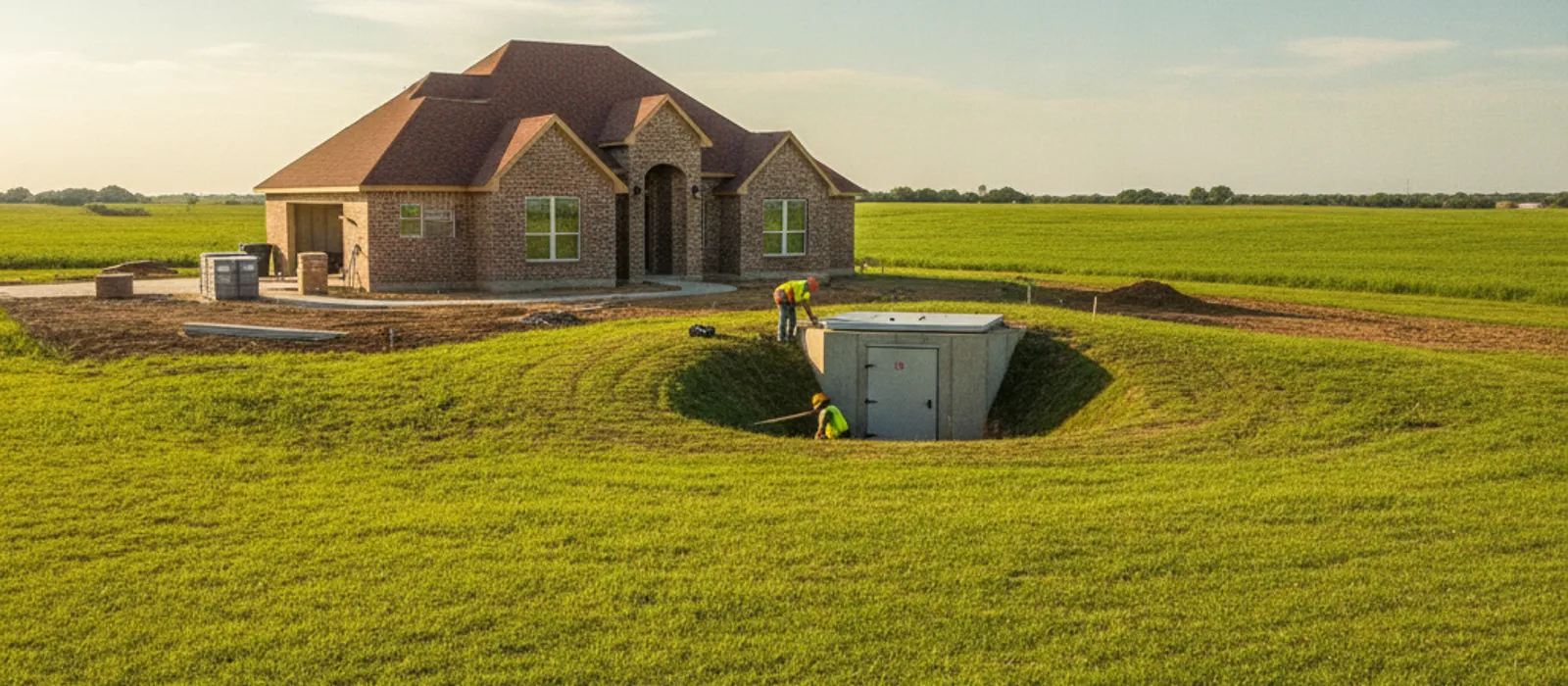
Above-ground safe rooms are increasingly popular, especially for homes without basements or where underground installation is not feasible. They are typically installed inside a garage, on a concrete slab, or as a standalone unit.
- Key Features: Constructed from heavy-gauge steel or reinforced concrete, anchored securely to the foundation, and equipped with a heavy-duty, outward-swinging door. They must meet ICC 500 standards.
- Advantages: Easy access, can often be used for other purposes (e.g., storage), and provide peace of mind during a storm.
- Eligibility: Highly eligible if built to ICC 500 standards. Learn more about our options at /above-ground-safe-rooms/.
Underground Storm Shelters
Underground shelters are a traditional and highly effective form of protection, buried beneath the ground with an entry hatch.
- Key Features: Made from steel or concrete, designed to withstand crushing forces from above, and typically feature a durable, inward-swinging door for safety. They must meet FEMA P-320 standards.
- Advantages: Excellent protection from wind-borne debris, consistent temperature, and out of sight.
- Eligibility: Highly eligible if built to FEMA P-320 standards. Explore our selection at /underground-storm-shelters/.
Garage Floor Shelters
These are a specific type of underground shelter installed flush with the garage floor, often beneath a vehicle parking space.
- Key Features: Similar construction to other underground shelters, but with a flush-mount lid that allows vehicles to park over it when not in use. Must meet FEMA P-320.
- Advantages: Space-saving, convenient access from inside the home, and discreet.
- Eligibility: Eligible if they adhere to FEMA P-320 guidelines. Discover more at /garage-floor-shelters/.
Commercial Storm Shelters
Federal grants also support the installation of larger, commercial-grade storm shelters for schools, businesses, and public buildings. These are designed to protect a greater number of people.
- Key Features: Often custom-engineered, larger capacity, and must meet ICC 500 standards for larger structures.
- Advantages: Provides safety for employees, students, or the general public during severe weather events.
- Eligibility: Often a primary target for BRIC and HMGP funds when applied for by local governments or school districts. Visit /commercial-storm-shelters/ for details.
Here’s a comparison of typical costs for different types of residential shelters before any grant or rebate:
| Shelter Type | Typical Capacity | Approximate Cost Range (Installation Included) | Key Standard |
|---|---|---|---|
| Above-Ground Safe Room | 4-16 people | $4,000 - $12,000 | ICC 500 |
| Underground Storm Shelter | 4-12 people | $4,500 - $10,000 | FEMA P-320 |
| Garage Floor Shelter | 4-10 people | $5,000 - $9,500 | FEMA P-320 |
Note: These are estimated costs and can vary based on size, features, materials, and specific installation requirements. We provide free written estimates tailored to your needs. For a comprehensive breakdown, see our /blog/storm-shelter-cost-guide/.
The Long-Term Value and Safety of Investing in a Certified Storm Shelter
While the availability of federal storm shelter grants can certainly influence a purchasing decision, the inherent value of a certified storm shelter extends far beyond any potential cost reduction. Investing in a FEMA P-320 or ICC 500 compliant safe room is an investment in unparalleled safety, peace of mind, and long-term property value.
North Texas is no stranger to severe weather. The threat of tornadoes is a constant concern for residents in Grayson, Fannin, and Cooke counties. Knowing you have a designated, tested, and certified shelter provides a level of security that no other mitigation measure can match. It means your family has a safe haven when minutes count, protecting them from deadly winds and flying debris.
Beyond immediate safety, a high-quality storm shelter can also positively impact your home’s value and even your insurance premiums. Many insurance companies offer discounts for homes equipped with certified safe rooms, recognizing the reduced risk of injury or structural damage. For more information on this, you might explore our article on /blog/storm-shelter-roi/.
- Local Case Example 3: In Gunter, a homeowner decided to install an above-ground safe room, even though no local rebate program was active at the time. The total cost was $7,500. A few years later, when selling their home, the certified safe room was a significant selling point, appealing to buyers concerned about severe weather. The agent noted it added perceived value and helped the home sell quicker, showcasing that the initial investment provided both safety and a tangible return.
Ultimately, the decision to install a storm shelter is about protecting what matters most. Whether or not you receive a grant, choosing a shelter that meets federal standards is paramount. These standards aren’t just bureaucratic hurdles; they represent decades of engineering and meteorological research designed to ensure maximum survivability. Texoma Storm Shelters is dedicated to providing these high-standard installations, ensuring your shelter performs when it’s needed most.
Don’t wait for a disaster to consider your family’s safety. Contact Texoma Storm Shelters for a free written estimate on a certified storm shelter or safe room. Call us at (903) 884-7210 or email info@texomatornadoshelters.com to discuss your options.
Partnering with Texoma Storm Shelters for Your Grant-Eligible Installation
Navigating the nuances of federal storm shelter grants and ensuring your installation meets the necessary requirements can be complex. This is where Texoma Storm Shelters becomes an invaluable partner. As your authoritative life-safety experts in Sherman and the wider North Texas region, we bring straightforward, practical, and reassuring expertise to every project.
Our commitment to installing shelters that meet or exceed FEMA P-320 and ICC 500 standards means that if a federal, state, or local grant program becomes available, your Texoma Storm Shelters installation will likely qualify. We provide:
- Expert Guidance: We can explain the technical specifications required for grant eligibility, helping you understand how our shelters align with federal standards. While we don’t handle grant applications directly, we provide all the necessary documentation for your shelter’s compliance.
- Certified Installations: Our team is licensed and insured, ensuring that every above-ground safe room, underground storm shelter, or garage floor shelter is installed precisely according to manufacturer specifications and federal guidelines. This is crucial for both your safety and any potential grant reimbursement.
- Transparent Pricing: We offer free written estimates, detailing all costs involved. This transparency helps you plan your budget and understand the investment, whether or not you secure grant funding.
- Local Understanding: We serve Grayson, Fannin, and Cooke counties, including Sherman, Denison, Pottsboro, Whitesboro, Van Alstyne, and Gunter. We understand the specific weather patterns and community needs of our area.
Choosing Texoma Storm Shelters means you are partnering with a company dedicated to your family’s safety. We stand by the quality and integrity of our installations, providing you with a robust, reliable defense against severe weather. Our emergency line is also available for severe weather and storm shelter installation inquiries, providing timely support when you need it most. We believe that every North Texas family deserves access to the highest standard of protection, and we are here to make that a reality.
Frequently Asked Questions
Can individuals apply directly for federal storm shelter grants?
No, individuals cannot directly apply for federal storm shelter grants from FEMA. Federal programs like BRIC and HMGP are typically awarded to states, tribal governments, and local jurisdictions. Homeowners benefit from these funds indirectly when their state or local government establishes a sub-grant or rebate program for residential storm shelters.
What are the key standards a storm shelter must meet to be grant-eligible?
For a storm shelter to be eligible for federal grant funding, it must meet the rigorous safety standards outlined in FEMA P-320 (for residential and small business safe rooms) and ICC 500 (Standard for the Design and Construction of Storm Shelters). These standards dictate requirements for design, construction materials, anchorage, and door strength to ensure the shelter can withstand extreme wind events.
How long does the grant application process typically take in Texas?
The timeline for federal storm shelter grants in Texas can vary significantly. From the initial federal announcement to state application, local program establishment, and individual reimbursement, the entire process can take many months or even over a year. It depends on the specific grant cycle, the complexity of the local program, and the volume of applications.
Does Texoma Storm Shelters help with the grant application process?
Texoma Storm Shelters focuses on providing expert installation of FEMA P-320 and ICC 500 compliant storm shelters. While we do not handle the grant application process directly for homeowners, we provide all necessary documentation and ensure our installations meet the technical requirements that grant programs typically demand. We offer free written estimates and can answer questions about shelter specifications for your application.